3D cell culture is revolutionizing the way scientists study cells and their interactions. Traditional 2D cultures often fail to replicate the complexity of living organisms. According to a report by Grand View Research, the global 3D cell culture market is expected to reach $4.3 billion by 2025. This rapid growth reflects the increasing recognition of the importance of 3D systems in drug discovery and regenerative medicine.
Dr. Laura O'Connell, a leading expert in tissue engineering, states, “3D cell culture provides a more realistic environment for cell behavior.” Her insight highlights the advantages of mimicking physiological conditions. By using scaffolds and biomaterials, researchers can create structures that better replicate organ systems. These advancements lead to more effective treatments and reduced reliance on animal testing.
However, challenges remain in fully standardizing 3D cell culture techniques. Many researchers express concerns about reproducibility and scalability. While the benefits are evident, many questions still linger about optimization and integration into existing research frameworks. The journey toward fully harnessing the power of 3D cell culture is ongoing, demanding continual innovation and reflection within the scientific community.
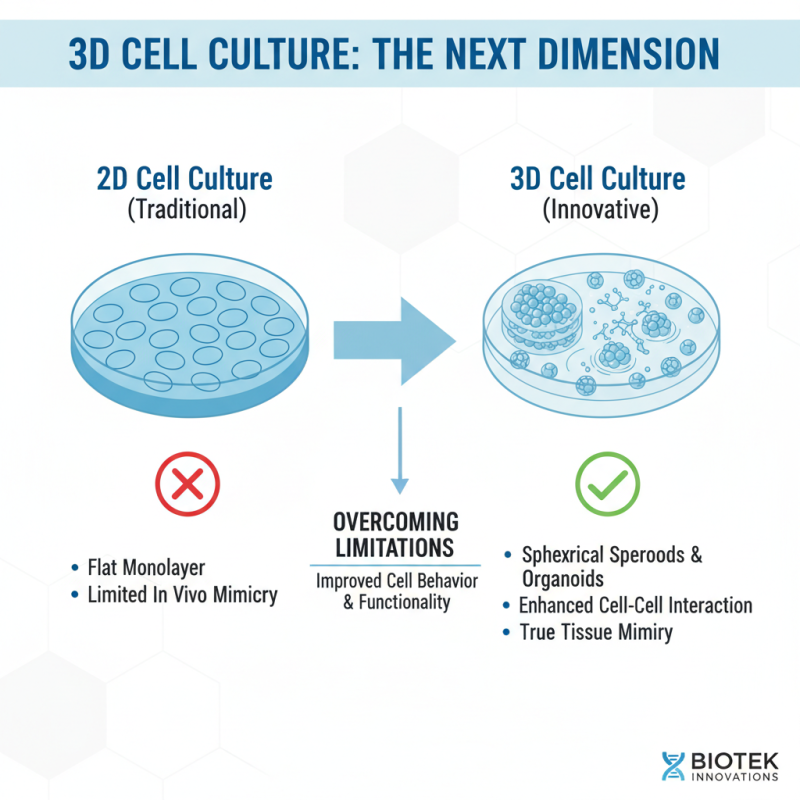
3D cell culture is an innovative approach to growing cells in a three-dimensional environment. Traditional 2D cultures have limitations. They do not accurately mimic the natural conditions of tissues in the body. In contrast, 3D cultures allow cells to organize and interact more like they would in vivo. This setup promotes better cell behavior and functionality.
The process typically involves scaffolds made from various materials. These scaffolds provide support and structure for the cells. This environment encourages cells to grow in clusters or layers. Sometimes, different cell types are combined to create more complex structures. However, creating a perfect replica of human tissues is still a challenge. Some cultures do not maintain the same characteristics over time.
Researchers face hurdles while optimizing 3D cell culture methods. They need to consider the nutrient supply and waste removal within these structures. Occasionally, the cells do not thrive as expected. This may lead to inconsistent results in research. Continuous improvement and exploration are essential for enhancing the relevance of 3D cultures in scientific studies.
3D cell culture has emerged as a vital technique in biomedical research. Unlike traditional 2D cultures, 3D cultures better mimic the natural environment of cells. This structure encourages cells to interact more cohesively. It also promotes complex tissue architectures. Researchers can observe how cells behave in a more realistic setting.
Creating effective 3D cell cultures is challenging. It requires careful selection of materials and methods. For instance, using hydrogels can support cell growth. However, not all hydrogels provide the same benefits. Some may limit cell interaction. It's important to test different combinations to find the best fit.
Tips: Always validate your 3D model. Regularly assess how well it represents native tissues. Keep in mind that results may vary. Experimentation is key. Document your findings even when results are unexpected. Each setback can offer valuable insights.
3D cell culture has emerged as a revolutionary method for studying cellular behaviors. It mimics the natural environment of cells better than traditional 2D cultures. Researchers use various techniques in 3D cell culture. These techniques enhance cell interactions and support tissue-like structures.
One common method is scaffold-based culture. Scaffolds can be made from natural or synthetic materials. They provide a framework for cells to grow. Cells multiply and organize into complex structures. However, controlling the uniformity of scaffold porosity can be challenging. If the pores are too large or small, it may affect cell viability.
Another approach is using hydrogel matrices. They offer a gel-like consistency that encourages cell mobility. Hydrogels can be chemically modified to replicate specific tissue environments. Unfortunately, the slow degradation of some hydrogels can hinder experiments. Researchers need to balance material degradation rates and cell integration. These techniques, while innovative, require careful optimization to ensure reliable results.
3D cell culture has transformed the landscape of medical research and application. Unlike traditional 2D cultures, 3D environments more closely mimic physiological conditions. This allows for better cell behavior analysis, drug responses, and tissue development studies. According to a recent report from Research and Markets, the global 3D cell culture market is expected to reach $1.4 billion by 2026. This growth reflects the significant advantages of 3D cultures in drug discovery and tissue engineering.
One major application of 3D cell culture is in cancer research. Researchers can better understand tumor microenvironments and the interactions within them. Using 3D cultures allows for testing drugs more effectively. A study published in Nature Biotechnology demonstrated that 3D cell cultures have a 50% higher prediction accuracy for drug response compared to 2D cultures.
Tips: When considering 3D cell culture, pay attention to the cell type and scaffold used. Different cell types may require specific conditions to thrive. Additionally, monitor the nutrient and waste exchange, as these factors are critical in maintaining healthy cell growth.
Another promising use of 3D culture is tissue engineering. It could lead to creating organs for transplantation. University research teams are exploring ways to develop functional tissues using 3D scaffolds. Yet, challenges remain with vascularization and survival of tissues. There’s still a need for more robust data in this area.
3D cell culture mimics the natural environment of cells. It offers better insights into cellular behavior. However, it is not without challenges. The complexity of replicating tissue structures is significant. Researchers often struggle with maintaining cell viability over long periods. Nutrient diffusion can be uneven in larger cultures, leading to inconsistencies.
Another challenge lies in the scalability of these systems. While small samples may behave predictably, scaling up can complicate results. Techniques used in 2D cultures may not directly translate to 3D settings. This leads to frustration for scientists seeking reliable data. Moreover, standardizing protocols is another hurdle. Variability across different labs can hinder progress.
Looking to the future, innovation is crucial. Developing more sophisticated scaffolds could improve cell growth. Incorporating advanced bioprinting technologies may also enhance precision. Additionally, integrating AI could lead to more robust data analysis. There’s a need for a collaborative approach within the scientific community. Sharing insights could accelerate solutions to current challenges.