In the realm of scientific research, secondary antibodies play a crucial role. These antibodies enhance detection methods in immunoassays. According to a recent industry report, the global secondary antibody market is projected to grow significantly, reaching over $1 billion by 2026. Researchers rely on these tools for various applications, from western blotting to immunofluorescence.
However, the selection of the best secondary antibodies remains challenging. Many factors influence their effectiveness, including specificity and affinity. A study highlighted that nearly 30% of researchers faced difficulties in choosing suitable antibodies. This frequent issue calls for more rigorous assessments. It is essential to address these challenges to optimize research outcomes.
Moreover, not all secondary antibodies are created equal. Quality varies among brands, and non-specific binding can lead to erroneous results. Each experiment demands careful consideration of the options available. Researchers must reflect on their choices. Balancing quality, availability, and cost is vital to achieving reliable results in experimental setups.

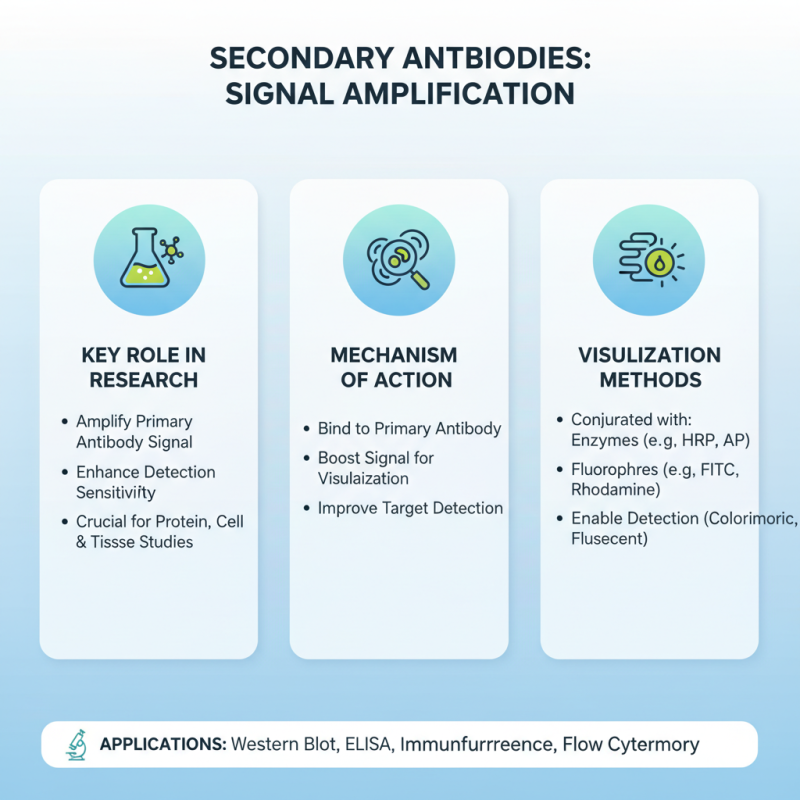
Secondary antibodies are crucial in many research applications. They amplify the signal from primary antibodies, enhancing detection sensitivity. Their role cannot be overstated when studying proteins, cells, or tissues. Often, they are conjugated with enzymes or fluorophores, enabling visualization.
When selecting secondary antibodies, consider species origin, isotype, and conjugation method. Different experiments may require unique configurations. It’s a bit overwhelming. Make choices based on targets and necessary detection methods.
**Tips:** Choose secondary antibodies that match your primary antibody’s host species for effective binding. Pay attention to concentration; higher isn’t always better. Test various options to find the best fit for your needs. Remember, even small adjustments can lead to improved outcomes in your experiments.

Selecting the best secondary antibodies is crucial for effective research. Key criteria can guide your decision. Start with specificity. A high degree of specificity ensures that antibodies bind only to their intended target. This reduces background noise and improves data clarity. Cross-reactivity can lead to misleading results, so it's essential to verify this aspect.
Next, consider sensitivity. More sensitive antibodies can detect lower concentrations of the primary antibody. This is especially important in applications like immunohistochemistry. Additionally, review the available data on the antibody's performance in various assays. Look for detailed validation studies that showcase reliability. It's important to note that not all antibodies perform well across different conditions.
Stability is another factor to weigh. Some antibodies have a shorter shelf life and may degrade over time. Check storage recommendations to maintain their efficacy. It's also worth reflecting on your specific experiment needs. Each application may require unique characteristics from a secondary antibody. Inadequate selection can lead to wasted resources and experiments that yield little information.
| Antibody Name | Source Type | Target Species | Isotype | Conjugate Type | Applications | Optimal Dilution |
|---|---|---|---|---|---|---|
| Anti-Mouse IgG | Rabbit | Mouse | IgG | HRP | WB, IF, ELISA | 1:2000 |
| Anti-Rabbit IgG | Goat | Rabbit | IgG | Fluorophore | ICC, FACS | 1:1000 |
| Anti-Goat IgG | Donkey | Goat | IgG | Biotin | WB, ELISA | 1:500 |
| Anti-Sheep IgG | Rabbit | Sheep | IgG | AP | IHC, WB | 1:250 |
| Anti-Human IgG | Goat | Human | IgG | Red Fluorophore | ELISA, IHC | 1:1000 |
When choosing secondary antibodies for research, consider key factors. Different applications require specific antibody characteristics. The ideal secondary antibody enhances detection while minimizing background noise. Various brands offer unique benefits, but selection can be challenging.
Reputable manufacturers prioritize quality and consistency. Some brands excel in producing antibodies for specific applications. Others offer a wider range of choices. However, even top manufacturers have inconsistencies. It's vital to read user reviews and conduct trials. Each laboratory may respond differently to the same product.
Remember, not all secondary antibodies produce reliable results. Batch variations can lead to unexpected outcomes. It's essential to evaluate how well an antibody performs in your unique experimental setup. Reflect on your lab’s previous experiences to make informed decisions.
Secondary antibodies play a crucial role in numerous research fields. They enhance the detection of primary antibodies in various assays. This is particularly important in immunohistochemistry. Here, visualization of specific proteins in tissues is essential. Secondary antibodies bind to primary ones, amplifying the signal.
In applications like flow cytometry, secondary antibodies are vital for cell analysis. Scientists can determine the expression of proteins on cell surfaces. However, issues can arise with cross-reactivity. This can lead to unexpected results. Researchers must carefully select secondary antibodies to mitigate these problems.
Western blotting also benefits from secondary antibodies for protein detection. The amplification they provide can reveal minuscule protein quantities. Yet, sensitivity varies among different secondary antibodies. This requires trial and error. Careful validation is necessary for reliable outcomes. Each research project presents unique challenges. Every choice in antibody selection matters greatly.
When using secondary antibodies in experiments, the right choice can enhance your results. Selecting an appropriate secondary antibody is critical. It should match your primary antibody's species. Cross-reactivity can lead to unwanted signals. Always verify the specificity through controls.
Optimizing conditions is essential for clear signals. Consider the dilution factor. Too concentrated can result in high background noise. You might need to adjust this based on your detection method. Incubation time also matters. Longer isn't always better. Monitor your assay and be ready to tweak your approach.
Keep in mind that not all antibodies work perfectly. Some might show weak signals or unexpected binding. Regularly test new lots or batches to ensure consistency. Documenting these observations can guide future experiments. Staying flexible and adaptive is crucial in research.
This bar chart represents the performance scores of different secondary antibodies commonly used in research. The data indicates their effectiveness in various experimental settings, aiding researchers in selecting the best options for their specific needs.